


If you’ve got a marketing budget and you’re trying to decide where to spend it, chances are Google Ads and Meta Ads are the first two platforms on your list. Both are massive, both are proven, and both can drive real revenue. But they work in fundamentally different ways — and picking the wrong one for your business model can mean burning budget with little to show for it.
Here’s how they actually compare, and how to figure out which one deserves your next ad dollar.
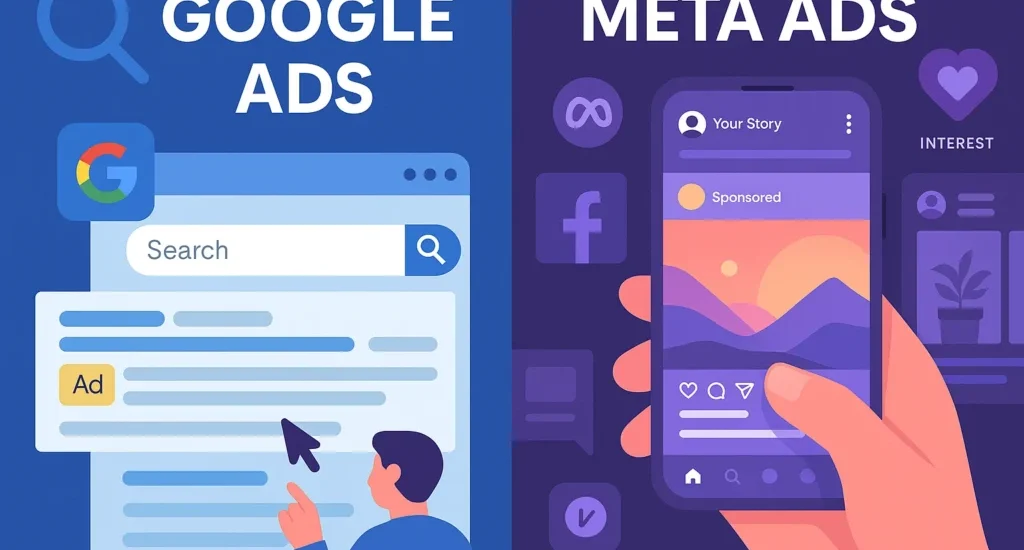
The Core Difference: Intent vs. Interest
This is the single most important distinction to understand.
Google Ads is intent-based. People are actively searching for something — “emergency plumber,” “best running shoes for flat feet,” “CRM software for small teams.” They already know what they want. Your ad shows up at the exact moment they’re looking for it.
Meta Ads is interest-based. People aren’t searching for anything. They’re scrolling Instagram or Facebook, and your ad interrupts that scroll based on their demographics, interests, and behavior. They didn’t ask to see it — you have to earn the stop.
This one difference shapes almost everything else about how each platform performs.
Google Ads: Strengths and Best Use Cases
Where it shines
- High-intent capture. You reach people who are ready to buy, book, or solve a problem right now.
- Local service businesses. Plumbers, dentists, lawyers, contractors — anyone with “near me” search demand benefits enormously.
- Clear ROI tracking. Conversion tracking ties directly to specific search terms, making it easier to measure what’s actually working.
- Search + Display + Shopping + YouTube. One platform, multiple formats, all built around the Google ecosystem.
Where it struggles
- Cost per click can get expensive fast, especially in competitive industries like insurance, legal services, or finance.
- Limited brand storytelling. Search ads are text-based and transactional — not great for building emotional connection or awareness.
- You’re at the mercy of search volume. If nobody’s searching for your product category yet, Google Ads can’t create that demand for you.
Ideal for
Businesses solving an immediate need: home services, healthcare, legal, B2B software with known competitors, e-commerce with branded or product-specific search demand.
Meta Ads: Strengths and Best Use Cases
Where it shines
- Visual storytelling. Image and video formats let you build brand identity, not just capture a transaction.
- Audience targeting and lookalikes. You can target by interests, behaviors, and create lookalike audiences based on your existing customers.
- Lower cost to start. Generally cheaper cost-per-click than Google in many industries, especially for testing.
- Great for impulse and discovery products. Fashion, beauty, home goods, food — things people didn’t know they wanted until they saw them.
Where it struggles
- Lower purchase intent. You’re creating demand, not capturing it — so conversion rates per click tend to be lower than search.
- iOS privacy changes have reduced targeting precision in recent years, making attribution less reliable than it used to be.
- Ad fatigue. Creative needs to be refreshed often, or performance drops as people see the same ad repeatedly.
Ideal for
Businesses with strong visual products, impulse-buy categories, brand-building goals, or younger target demographics who spend significant time on Instagram and Facebook.
A Side-by-Side Snapshot
| Factor | Google Ads | Meta Ads |
|---|---|---|
| Targeting basis | Search intent | Interests & demographics |
| Best funnel stage | Bottom (ready to buy) | Top to middle (awareness, consideration) |
| Format strength | Text, Shopping, YouTube | Image, video, Stories, Reels |
| Typical CPC | Higher in competitive niches | Generally lower |
| Brand building | Limited | Strong |
| Measurement clarity | Very direct | Less direct post-iOS14 |
So Which One Should You Choose?
For most small businesses, this isn’t actually an either/or decision — it’s a sequencing and budget-split question.
Start with Google Ads if:
- People actively search for what you sell or the problem you solve
- You’re a local or service-based business
- You need leads or sales quickly and have a tight budget for testing
Start with Meta Ads if:
- Your product is visual and benefits from being “discovered”
- You’re building a new brand with little existing search demand
- You want to grow an audience and retarget them across the funnel later
Use both if:
- You have budget to test (even $500–1,000/month split across platforms is enough to learn)
- You’re already running one and want to expand reach into earlier or later funnel stages
- You’re an e-commerce brand — Meta often drives discovery, while Google (especially Shopping ads) captures the resulting branded searches
The Smartest Approach: Let the Data Decide
If you’re unsure, the most reliable way to choose isn’t theory — it’s a structured test:
- Run both platforms for 4–6 weeks with a modest, equal budget
- Track cost per lead/sale, not just clicks or impressions
- Look at which platform brings in customers who actually convert and stick around, not just the cheapest leads
- Reallocate budget toward whichever platform is producing better unit economics — then revisit quarterly, since costs and audience behavior shift over time
Neither platform is universally “better.” The right answer depends on whether your customers are searching for you or waiting to be shown you — and most growing businesses eventually need both.ing them to explore further or apply what they’ve learned.