

How AI Is Changing Digital Marketing in 2026: Trends, Benefits & Future Insights
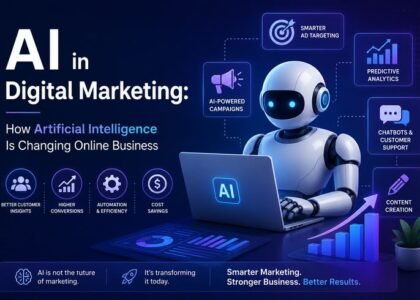
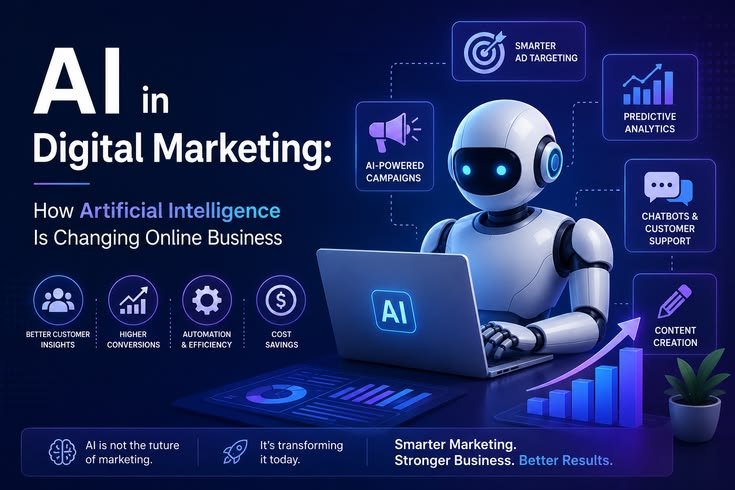
Artificial intelligence (AI) is changing the way businesses attract customers, create content, analyze data, and run digital marketing campaigns. From AI-powered search and personalized advertising to automated customer support and content creation, AI is becoming an important part of modern digital marketing strategies.
For businesses, the opportunity is not simply to use AI to produce more content. The real advantage comes from using AI to understand customers better, make faster decisions, personalize experiences, and improve marketing performance.
In 2026, digital marketing is becoming more intelligent, data-driven, and personalized. Businesses that combine AI with human creativity and strategic thinking can build stronger brands and generate better results.
How AI Is Changing Digital Marketing’
What Is AI in Digital Marketing?
How AI Is Changing Digital Marketing’
AI in digital marketing refers to the use of artificial intelligence technologies to analyze information, understand customer behavior, automate repetitive tasks, personalize marketing experiences, and support business decisions.
AI can help marketers with tasks such as:
- Keyword and audience research
- Content planning and optimization
- Search engine optimization (SEO)
- Paid advertising
- Social media marketing
- Email marketing
- Customer segmentation
- Chatbots and customer support
- Marketing analytics
- Lead generation
- Predictive analysis
Instead of replacing marketers, AI can act as a powerful assistant that helps marketing teams work faster and make more informed decisions.
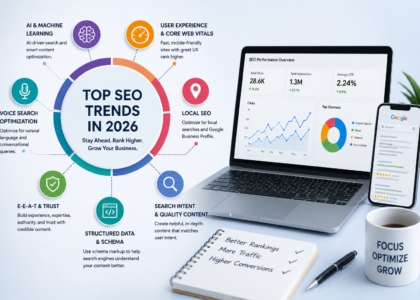
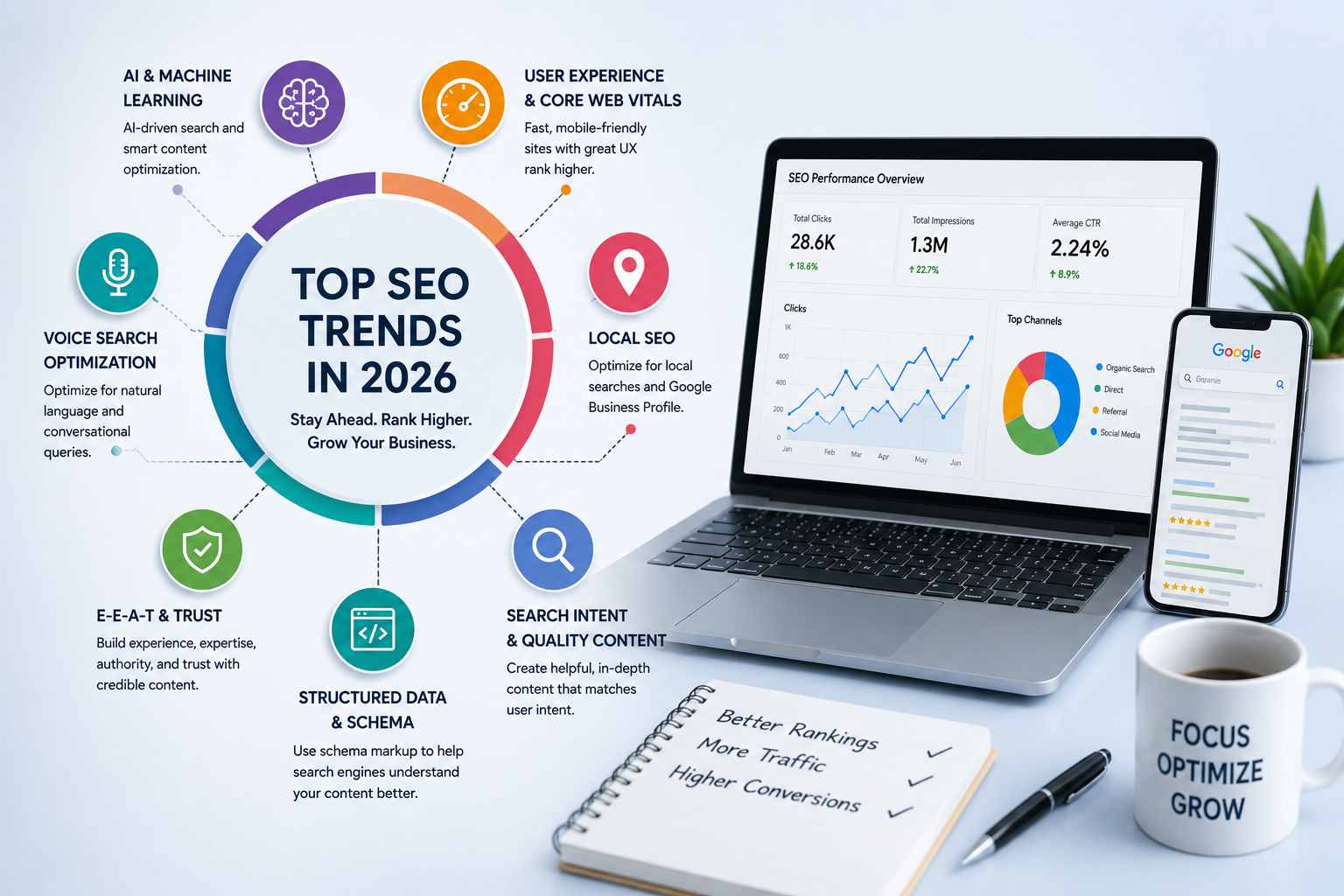
1. AI Is Transforming Search and SEO
1. AI Is Transforming Search and SEO
Search behavior is changing rapidly as search engines increasingly use AI to understand questions, context, intent, and relationships between topics.
Google says its systems focus on helpful, reliable, people-first content, regardless of whether AI was involved in its production. Content created primarily to manipulate search rankings, however, can violate Google’s spam policies.
This means businesses should not simply publish large volumes of AI-generated articles.
Instead, an effective AI-powered SEO strategy should combine:
- AI-assisted keyword research
- Search intent analysis
- Topic clustering
- Content optimization
- Competitor research
- Human expertise
- Original examples and insights
- Technical SEO
- Strong internal linking
- High-quality backlinks
The goal is simple: create content that is genuinely useful to people while making it easy for search engines and AI-powered search systems to understand.
2. Personalized Marketing Is Becoming More Powerful
How AI Is Changing Digital Marketing’
Customers expect brands to understand their needs.
AI can analyze customer behavior, interests, previous interactions, browsing patterns, and purchasing signals to help businesses deliver more relevant marketing messages.
For example, an online business can use AI to recommend products based on previous customer activity. A service business can segment leads according to their interests and send more relevant follow-ups.
Personalization can improve:
- Customer engagement
- Conversion rates
- Lead quality
- Customer experience
- Retention
- Marketing efficiency
Instead of showing the same message to everyone, businesses can create more relevant experiences for different customer segments.
This means businesses can get more value from their ad spend, even with smaller budgets, because AI is constantly optimizing in the background.
3. AI Is Changing Content Marketing
Content creation is one of the areas where AI has had the biggest impact.
AI tools can help marketers brainstorm topics, create outlines, analyze search intent, summarize research, generate content ideas, and improve existing drafts.
However, AI should not become a replacement for original thinking.
Google’s guidance specifically recommends focusing on accuracy, quality, relevance, and added value when using generative AI. Generating large numbers of pages without adding value can create problems under Google’s scaled-content-abuse policies.
A better approach is:
AI + Human Expertise + Original Insights = Better Content
For example, a digital marketing agency can use AI to research a topic but add its own campaign experience, case studies, client examples, data, screenshots, and practical recommendations.
That makes the content more useful and more difficult to replace with generic AI-generated information.
4. AI Is Improving Google Ads and Paid Advertising
How AI Is Changing Digital Marketing’
AI is also changing PPC and online advertising.
Modern advertising platforms can use machine learning to analyze signals and help marketers identify potential customers, optimize campaigns, and allocate advertising budgets.
AI can assist marketers with:
- Audience targeting
- Ad copy ideas
- Campaign analysis
- Conversion prediction
- Budget optimization
- Creative variations
- Customer segmentation
- Performance analysis
For example, instead of manually creating dozens of advertising variations, marketers can use AI to generate different headlines and descriptions and then use campaign data to identify which messaging performs best.
Human oversight is still important because advertising strategy involves business goals, positioning, budgets, brand voice, and customer understanding.
5. AI Is Transforming Social Media Marketing
How AI Is Changing Digital Marketing’
Social media marketers have to create content consistently across multiple platforms.
AI can help businesses:
- Generate content ideas
- Create post variations
- Analyze audience interests
- Identify trends
- Create content calendars
- Improve captions
- Repurpose existing content
- Analyze campaign performance
A single blog post can also be transformed into multiple social media posts, short-form video ideas, carousel concepts, email content, and discussion topics.
This allows small businesses to maintain a more consistent online presence without spending all day creating content.
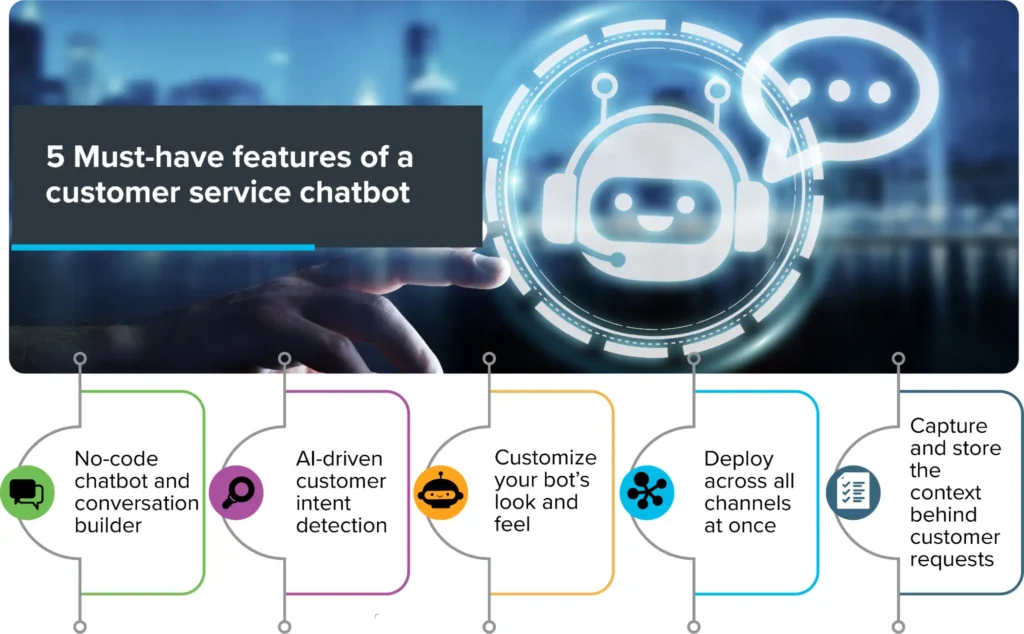
6. AI-Powered Chatbots Are Improving Lead Generation
How AI Is Changing Digital Marketing’
AI chatbots are becoming increasingly useful for businesses that receive leads through their websites.
A traditional contact form may simply collect a visitor’s name, phone number, email address, and message.
An AI-powered chatbot can go further by answering common questions, understanding customer requirements, recommending services, and guiding visitors toward the next step.
For example, a digital marketing website could use an AI chatbot to ask:
What service are you interested in?
The visitor might select:
- SEO
- Google Ads
- Social Media Marketing
- Website Development
- Lead Generation
The chatbot can then provide relevant information and encourage the visitor to request a consultation.
This can help businesses respond to prospects even outside normal working hours.
7. AI Is Making Marketing Analytics Smarter
Digital marketing produces enormous amounts of data.
Marketers need to understand:
- Where website visitors come from
- Which keywords generate traffic
- Which campaigns generate leads
- Which pages convert visitors
- Which audiences respond to advertisements
- Where customers leave the buying journey
AI can help analyze large datasets and identify patterns that may be difficult to notice manually.
Instead of simply looking at a dashboard full of numbers, marketers can use AI-assisted analysis to ask questions such as:
Which campaign generated the highest-quality leads?
Which landing page has the best conversion rate?
Which audience is most likely to convert?
This can help businesses make faster, data-driven decisions.
8. AI Is Changing Customer Experience
Customer expectations are increasing.
People want fast answers, personalized communication, and convenient interactions.
AI can support customer experience through:
- 24/7 chat support
- Automated responses
- Personalized recommendations
- Lead qualification
- Frequently asked question systems
- Follow-up automation
- Customer sentiment analysis
However, businesses should not automate every customer interaction.
Some situations require empathy, creativity, negotiation, or expert human assistance. The strongest strategy is often a combination of AI automation and human support.
9. AI Is Creating New Opportunities for Small Businesses
AI is not only useful for large corporations.
Small businesses and startups can use AI to compete more efficiently by reducing the time required for repetitive marketing tasks.
For example, a small business can use AI to help with:
SEO: Keyword research and content planning
Social Media: Content ideas and post creation
Advertising: Ad variations and performance analysis
Customer Service: Automated answers to common questions
Email Marketing: Personalized campaigns
Analytics: Identifying trends and opportunities
This allows small marketing teams to accomplish more without dramatically increasing their workload.
10. The Human Element Is Still Essential
One of the biggest misconceptions about AI in digital marketing is that AI will completely replace marketers.
AI can process information quickly, but successful marketing requires more than information.
Marketing also requires:
- Creativity
- Brand positioning
- Emotional understanding
- Strategic thinking
- Customer knowledge
- Storytelling
- Experience
- Decision-making
AI can suggest 20 headlines, but a marketer needs to understand which headline fits the brand.
AI can identify keywords, but an SEO professional needs to understand search intent and business objectives.
AI can generate an advertisement, but a marketing strategist needs to decide what the business should actually communicate.
The future of digital marketing is therefore not simply AI versus humans.
It is AI + humans.
How Businesses Should Use AI in Digital Marketing
Businesses should approach AI strategically rather than using it simply because it is trending.
A practical AI marketing strategy can include:
Step 1: Identify repetitive tasks
Find marketing activities that consume significant time but do not require constant human decision-making.
Step 2: Use AI for research and efficiency
Use AI to support research, brainstorming, analysis, content planning, and repetitive processes.
Step 3: Add human expertise
Review, edit, fact-check, and improve AI-assisted content with real business experience and original insights.
Step 4: Measure performance
Track traffic, leads, conversions, engagement, advertising performance, and revenue.
Step 5: Keep improving
AI technology is evolving quickly. Businesses should continuously test new tools and workflows while keeping their marketing strategy focused on customer needs.
The Future of AI in Digital Marketing
AI is changing the entire customer journey—from discovery and search to advertising, communication, conversion, and retention.
Google’s 2026 marketing outlook highlights AI’s growing role in how consumers explore information and make decisions, including more conversational and multimodal search experiences.
This means businesses need to think beyond traditional search rankings.
Modern digital marketing increasingly involves being visible wherever customers search, compare, ask questions, and make decisions.
That includes:
- Traditional search engines
- AI-powered search experiences
- Social media
- Video platforms
- Business websites
- Online communities
- Local search
- Digital advertising
Businesses that build strong brands, publish useful content, demonstrate real expertise, and maintain accurate online information will be better positioned for this changing environment.
Final Thoughts
AI is changing digital marketing by making campaigns faster, more personalized, data-driven, and scalable.
But AI alone does not create successful marketing.
The businesses that benefit most will be those that use AI as a strategic tool while maintaining human creativity, expertise, originality, and customer understanding.
For SEO and content marketing in particular, the lesson is clear: don’t use AI to create more content simply for the sake of creating content. Use AI to create better marketing.
AI in digital marketing is still evolving quickly. What started with simple email automation has grown into tools that can write content, predict behavior, and personalize entire customer journeys. Businesses that learn to use these tools thoughtfully — while keeping a human touch — will have a real advantage.
The future belongs to businesses that combine technology with strategy—and automation with human creativity.
If your business wants to improve its online visibility, generate more qualified leads, and build a stronger digital presence, working with an experienced digital marketing team can help turn these AI opportunities into measurable business results.
Ready to grow your business online? Contact ResultWise Digital to explore SEO, Google Ads, social media marketing, website development, and lead-generation strategies designed around your business goals.