
Likes feel good. Followers look impressive. But do they actually grow your business?
In digital marketing, it is easy to become obsessed with likes, comments, shares and follower counts. These numbers are visible and exciting—but they don’t always tell you whether your marketing is generating revenue.
A business can have thousands of followers and still struggle to generate customers.
On the other hand, a smaller business with the right strategy can generate consistent leads and sales from a much smaller audience.
The real question is not:
“How many people liked my post?”
It is:
“How many people did my marketing turn into genuine business opportunities?”
At ResultWise Digital, we believe digital marketing should be measured by results. Here are seven metrics that deserve much more attention than likes.
1. Leads Generated
A lead is someone who shows genuine interest in your product or service.
Examples include:
- Contact form submissions
- Phone calls
- WhatsApp enquiries
- Demo requests
- Consultation bookings
- Quote requests
- Newsletter or enquiry sign-ups
If your campaign generates 5,000 impressions but only two enquiries, something needs to be improved.
If another campaign generates 500 impressions and 25 qualified enquiries, the second campaign may be far more valuable.
Track: Total qualified leads generated per campaign and per marketing channel.
2. Conversion Rate
Traffic alone doesn’t pay the bills.
Conversion rate tells you how effectively your website or landing page turns visitors into leads or customers.
For example:
If 1,000 people visit your website and 40 submit an enquiry:
Conversion Rate = 4%
A low conversion rate can indicate problems with:
- Website design
- Page speed
- Messaging
- Trust signals
- Call-to-action
- Pricing information
- Landing-page experience
Sometimes you don’t need more traffic—you need to convert more of the traffic you already have.
3. Cost Per Lead
If you are running paid advertising, one of the most important numbers is Cost Per Lead (CPL).
For example:
You spend ₹20,000 on advertising and generate 100 leads.
Cost Per Lead = ₹200
But the cheapest lead isn’t necessarily the best lead.
A campaign generating leads at ₹200 each may be less profitable than one generating leads at ₹500 if the ₹500 leads are much more likely to become customers.
That’s why CPL should always be evaluated alongside lead quality and sales.
4. Customer Acquisition Cost (CAC)
Cost Per Lead tells you what it costs to generate an enquiry.
Customer Acquisition Cost tells you what it costs to acquire an actual customer.
For example:
Your business spends ₹50,000 across marketing and sales activities and gains 25 new customers.
CAC = ₹2,000 per customer
This number helps you understand whether your marketing is financially sustainable.
If your average customer generates ₹10,000 in profit, spending ₹2,000 to acquire that customer could make sense.
If your profit is only ₹1,000, the strategy needs to change.
5. Return on Ad Spend (ROAS)
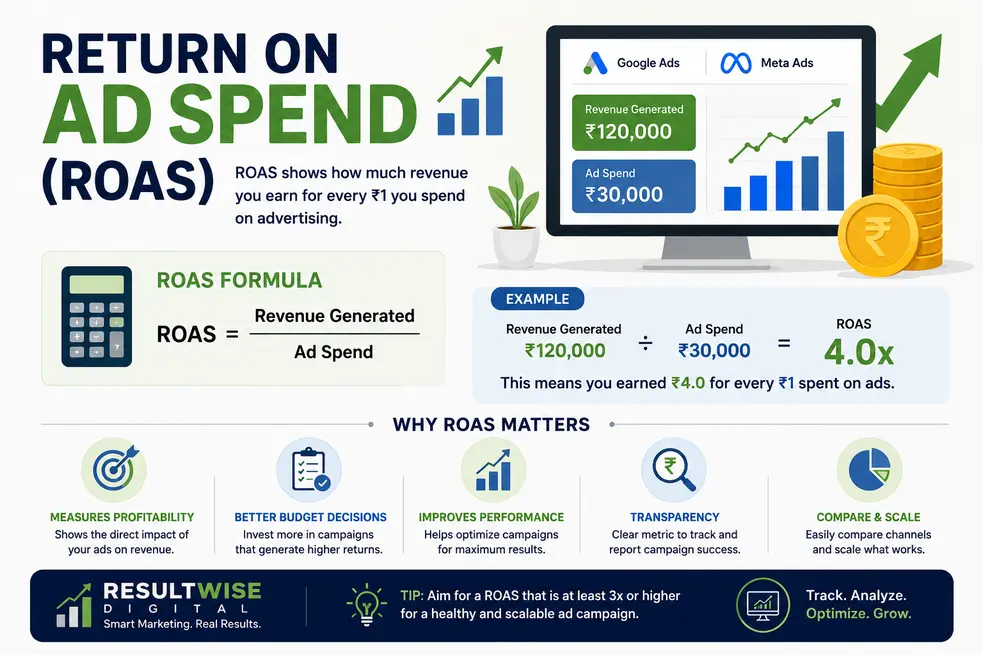
For businesses running paid advertising, ROAS is another important metric.
The basic formula is:
ROAS = Revenue Generated ÷ Advertising Spend
Suppose you spend ₹30,000 on Google or Meta Ads and generate ₹120,000 in attributed revenue.
Your ROAS is:
4X
That means you generated ₹4 in revenue for every ₹1 spent on advertising.
However, remember that revenue is not the same as profit. Businesses should also consider product margins, operational costs and other expenses when evaluating campaign performance.
6. Customer Lifetime Value (CLV)
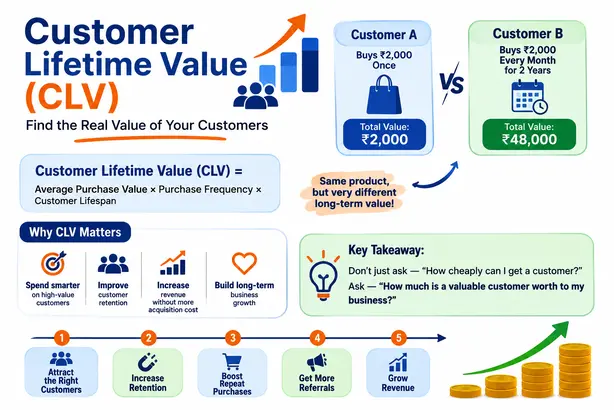
Not every customer is worth the same amount.
Imagine two customers:
Customer A: Purchases ₹2,000 once.
Customer B: Purchases ₹2,000 every month for two years.
Their initial transactions may look similar, but their long-term value is very different.
Customer Lifetime Value helps businesses understand the potential revenue generated by a customer throughout their relationship with the business.
This can change how you approach marketing.
Instead of asking:
“How cheaply can I get a customer?”
you can ask:
“How much is a valuable customer worth to my business?”
That is a much smarter question.
7. Revenue & Marketing ROI
Ultimately, businesses need to connect marketing activity with business results.
You should be able to answer questions such as:
- How much did we spend?
- How many qualified leads did we generate?
- How many became customers?
- How much revenue came from those customers?
- Which marketing channel generated the best return?
- Which campaigns should we scale?
- Which campaigns should we stop?
This is where digital marketing becomes a business growth system rather than simply a social media activity.
What About Likes, Followers and Engagement?
Does this mean likes and followers don’t matter?
Not necessarily.
They can be useful supporting metrics.
Engagement can help you understand whether your content resonates with your audience. Follower growth can indicate whether your audience is expanding.
But they shouldn’t become the final measure of marketing success.
Think of it this way:
Likes = Attention
Traffic = Interest
Leads = Opportunity
Customers = Business
Revenue & Profit = Results
The closer your metrics are to actual business outcomes, the more useful they become for decision-making.
Build a Marketing Dashboard That Matters
Instead of checking social media likes every morning, create a simple monthly dashboard containing:
| Metric | What It Tells You |
|---|---|
| Website Traffic | How many people are reaching your website |
| Leads | How many potential customers you generated |
| Conversion Rate | How effectively traffic becomes leads |
| Cost Per Lead | How efficiently you generate enquiries |
| Customer Acquisition Cost | Cost of acquiring customers |
| ROAS | Revenue generated from advertising |
| Customer Lifetime Value | Long-term customer value |
| Revenue | Business outcome from marketing |
This gives you a much clearer picture of what is actually working.
The ResultWise Approach: Smart Marketing. Real Results.
Digital marketing shouldn’t be about collecting likes just to make a monthly report look impressive.
It should help your business:
Reach the right audience → Generate quality leads → Convert prospects → Acquire customers → Increase revenue
That requires more than posting regularly.
It requires the right combination of:
- SEO
- Google Ads
- Social Media Marketing
- Website & Landing Page Optimization
- Content Marketing
- Lead Generation
- Conversion Optimization
- Data-driven strategy
At ResultWise Digital, our focus is simple:
Smart Marketing. Real Results.
Because the best marketing report isn’t the one with the most likes.
It’s the one that shows measurable business growth.
Ready to Measure What Actually Matters?
If your business is investing in digital marketing but you’re not sure which campaigns are actually generating leads and customers, it may be time to look beyond vanity metrics.
Let’s build a digital marketing strategy focused on measurable results—not just likes.
ResultWise Digital
Smart Marketing. Real Results.
Website: resultwise.in