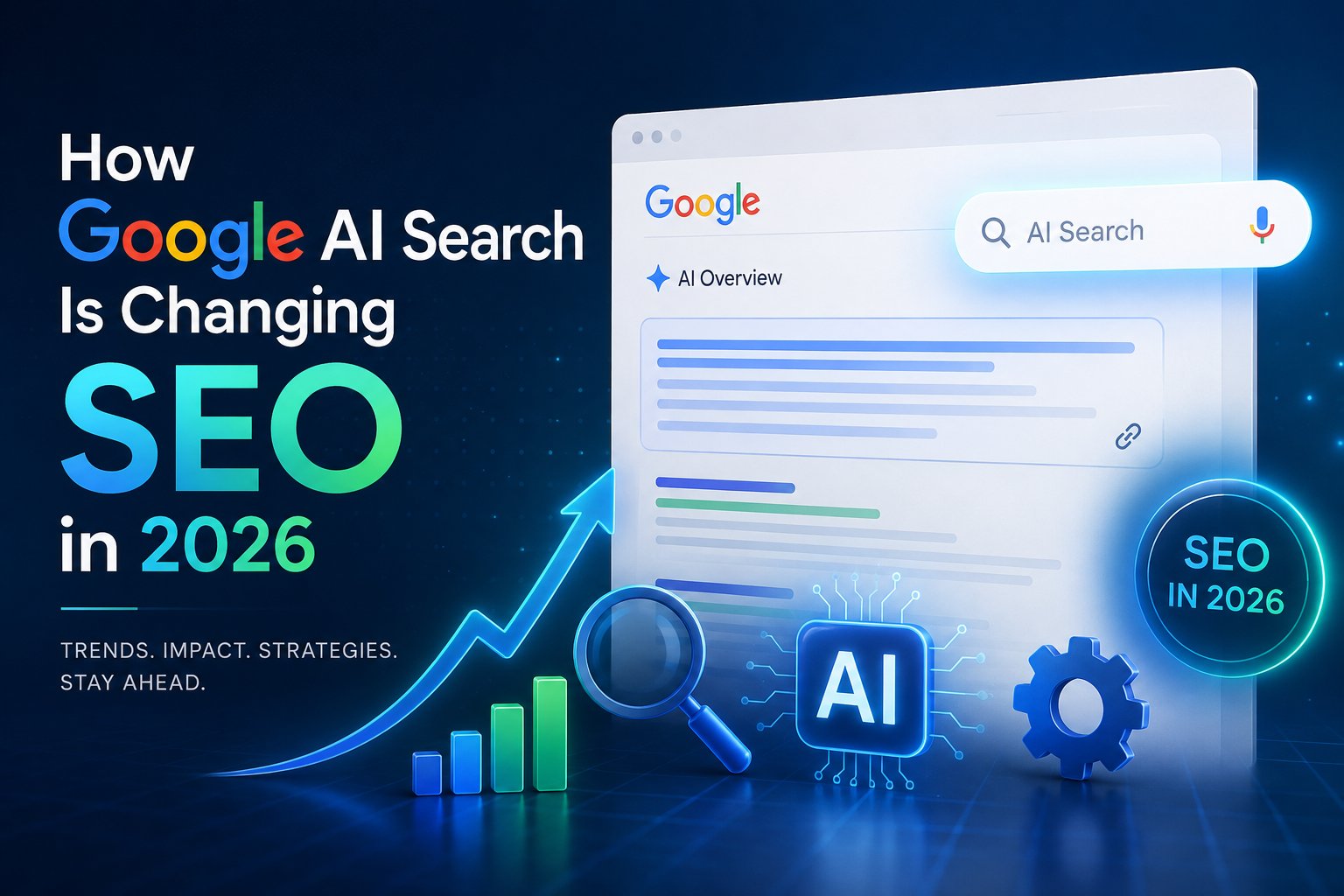
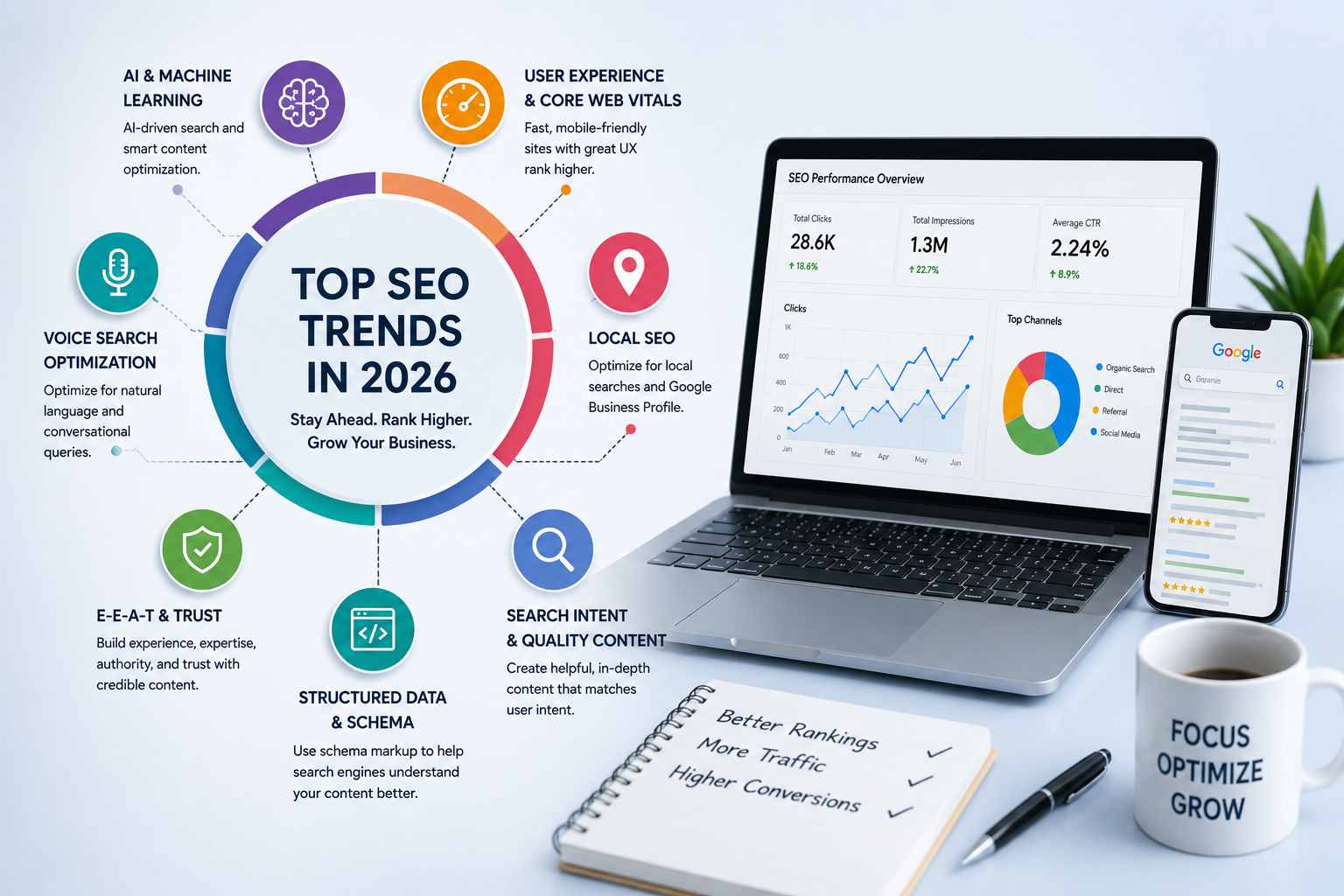


How Google AI Search Is Changing SEO in 2026 – Google Search is changing faster than ever.
For years, businesses focused on ranking their websites on Google’s traditional search results. The goal was straightforward: choose the right keywords, optimize pages, build backlinks and reach the first page of Google.
In 2026, search is becoming much more conversational and AI-driven.
Google’s AI Overviews and AI Mode can provide users with AI-generated answers, comparisons and explanations while also showing links to supporting websites. Google says these AI experiences are built on its existing Search systems, meaning SEO remains important even as the way users interact with search changes.
This means businesses should not think of AI Search as the end of SEO.
Instead, SEO is evolving from simply ranking for keywords to becoming visible, useful and trustworthy across increasingly complex search journeys.
So, how exactly is Google AI Search changing SEO in 2026?
Let’s explore.
What Is Google AI Search?
Google AI Search
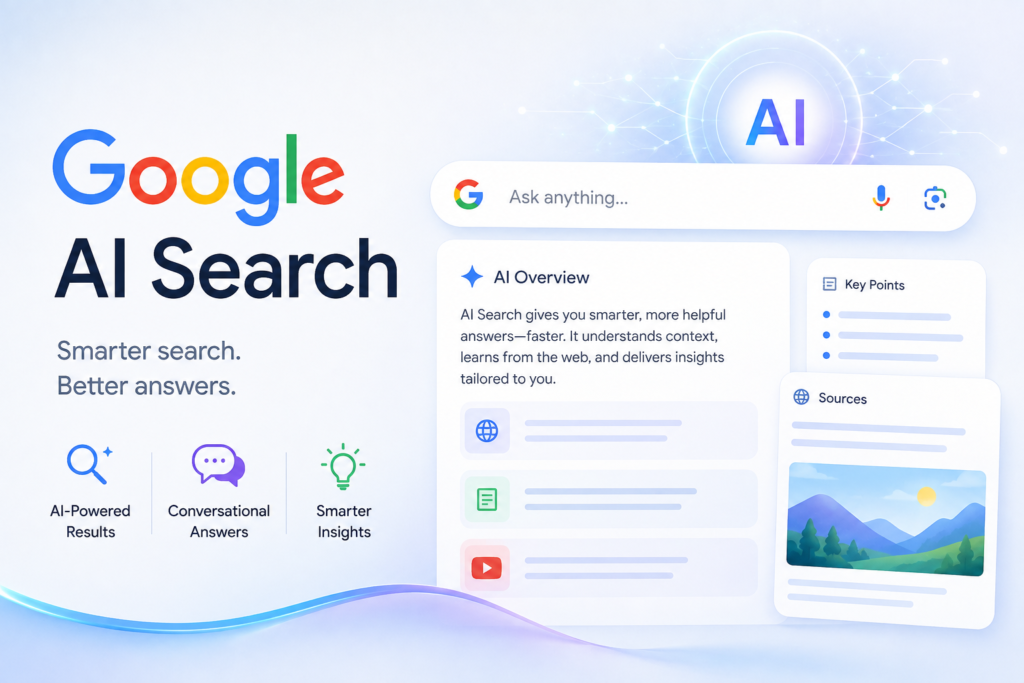
Google AI Search refers to AI-powered experiences within Google Search that help users find and understand information more efficiently.
Two important experiences are:
AI Overviews
AI Overviews provide an AI-generated summary for certain searches and include links that users can follow to explore information in greater depth.
They are designed to help users understand complicated topics more quickly while providing access to supporting websites.
AI Mode
AI Mode is designed for more complex searches where users may want additional exploration, reasoning or comparisons.
Instead of making several separate searches, users can ask a more detailed question and continue the conversation with follow-up questions.
Google explains that AI Mode and AI Overviews can use a technique called query fan-out, where multiple related searches may be performed across different subtopics and sources to develop an answer.
This creates a major opportunity for websites that provide comprehensive and genuinely useful information.
Why Google AI Search Matters for SEO in 2026
Google AI Search
Traditional SEO often focused on questions such as:
“What keyword should I target?”
AI Search requires businesses to think more broadly:
“What information does the user actually need?”
A user searching for:
“best digital marketing agency in Delhi”
may previously have looked through a list of websites.
Today, the same user may ask:
“What should I look for when choosing a digital marketing agency in Delhi for SEO and Google Ads?”
The search journey becomes more conversational and detailed.
Google’s AI experiences are designed to help with these types of complex searches and can surface a wider range of supporting links.
Therefore, businesses need content that answers not just one keyword, but the broader questions surrounding their customers’ decisions.
7 Ways Google AI Search Is Changing SEO in 2026
Google AI Search
1. Search Is Becoming More Conversational
Users are increasingly able to search using natural-language questions rather than short keyword phrases.
Instead of:
“SEO agency Delhi”
users may search:
“Which SEO services does a small business in Delhi need to generate leads?”
This changes how businesses should create content.
Rather than repeatedly inserting exact-match keywords, create content that naturally answers related questions and explains the topic comprehensively.
Google’s current guidance specifically says websites do not need to rewrite content in a special format for AI systems or include every possible variation of a keyword. Google’s systems can understand related concepts and meanings.
What to do
Create content around:
- Questions
- Problems
- Comparisons
- Solutions
- Use cases
- Industry-specific needs
- Buying decisions
- Frequently asked questions
2. Keyword Ranking Alone Is No Longer the Whole Goal
Ranking number one remains valuable.
But SEO success in 2026 should not be measured only by traditional rankings.
Your website can potentially appear through different search experiences, including traditional organic results and AI-powered experiences.
This means businesses should monitor:
- Organic impressions
- Organic clicks
- Rankings
- Conversions
- Engagement
- Leads
- Branded searches
- Visibility in AI features
Google introduced dedicated Search Console reporting for generative AI visibility in 2026, including information about impressions and pages appearing in generative AI features. The rollout is being made available progressively.
The SEO goal is shifting from “rank for a keyword” to “become a useful source throughout the search journey.”
3. Helpful and Original Content Is Becoming More Important
AI can generate thousands of articles in seconds.
That means generic content is becoming easier to produce — and less valuable.
Google’s guidance emphasizes unique, valuable, people-first content and warns against simply recycling information that already exists online.
For example, instead of writing:
“SEO is important because it helps websites get traffic.”
provide something more useful:
- Explain your SEO process.
- Show real examples.
- Explain common mistakes.
- Provide practical recommendations.
- Include original observations.
- Answer customer questions.
- Use relevant statistics and sources.
- Explain what businesses should do next.
The more useful your content is to a real customer, the stronger its potential value in both traditional and AI-powered search.
4. Topical Authority Matters More Than Publishing Random Blogs
Publishing 100 unrelated articles is not necessarily better than creating 20 highly relevant articles around your core expertise.
For a digital marketing agency, for example, you could build topic clusters around:
SEO
- What Is SEO?
- Technical SEO Guide
- Local SEO
- SEO for Small Businesses
- SEO vs PPC
- SEO Mistakes
- SEO Trends in 2026
Google Ads
- Google Ads for Small Businesses
- Google Ads vs SEO
- PPC Budget Guide
- Google Ads Conversion Tracking
- Common Google Ads Mistakes
Website Development
- Website Development Guide
- Website Speed Optimization
- Mobile-Friendly Websites
- Website Conversion Optimization
- Landing Page Best Practices
This approach helps create a strong content ecosystem where related pages support one another.
5. Internal Linking Is Becoming Even More Valuable
When creating AI-friendly and SEO-friendly content, don’t publish isolated articles.
Connect related pages.
For example, this article could internally link to:
- SEO Services
- Digital Marketing Services
- Google Ads Services
- Website Development Services
- Local SEO Services
- Relevant ResultWise blog articles
Google’s AI Search guidance specifically recommends making content easy to discover through internal links.
A good internal linking structure helps users discover additional information and helps search engines understand relationships between pages.
6. Technical SEO Still Matters
One of the biggest misconceptions about AI Search is that traditional SEO is becoming irrelevant.
Google says the opposite.
Pages need to meet Google’s normal technical requirements and be eligible to appear in Search before they can be considered as supporting links in AI Overviews or AI Mode.
Important technical SEO factors include:
- Crawlability
- Indexability
- Mobile usability
- Page experience
- Internal linking
- HTTPS
- Proper canonicalization
- XML sitemap
- Clean URL structure
- Fast-loading pages
- Accessible text content
- Correct structured data
AI Search does not eliminate technical SEO.
It makes technical SEO the foundation on which AI visibility is built.
7. Structured Data Helps — But There Is No “AI Schema”
Google AI Search
There is a lot of discussion online about special schema markup for AI Search.
However, Google currently says there is no special schema.org markup required specifically for AI Overviews or AI Mode. Existing SEO and structured-data best practices remain useful.
For example, businesses can still use appropriate structured data such as:
- Organization
- LocalBusiness
- Article
- BreadcrumbList
- Service
- WebSite
The important rule is that structured data should accurately represent the visible content on the page.
Don’t add schema simply because someone claims it will “force” Google AI to mention your website.
There is no guaranteed shortcut.
How to Optimize Your Website for Google AI Search in 2026
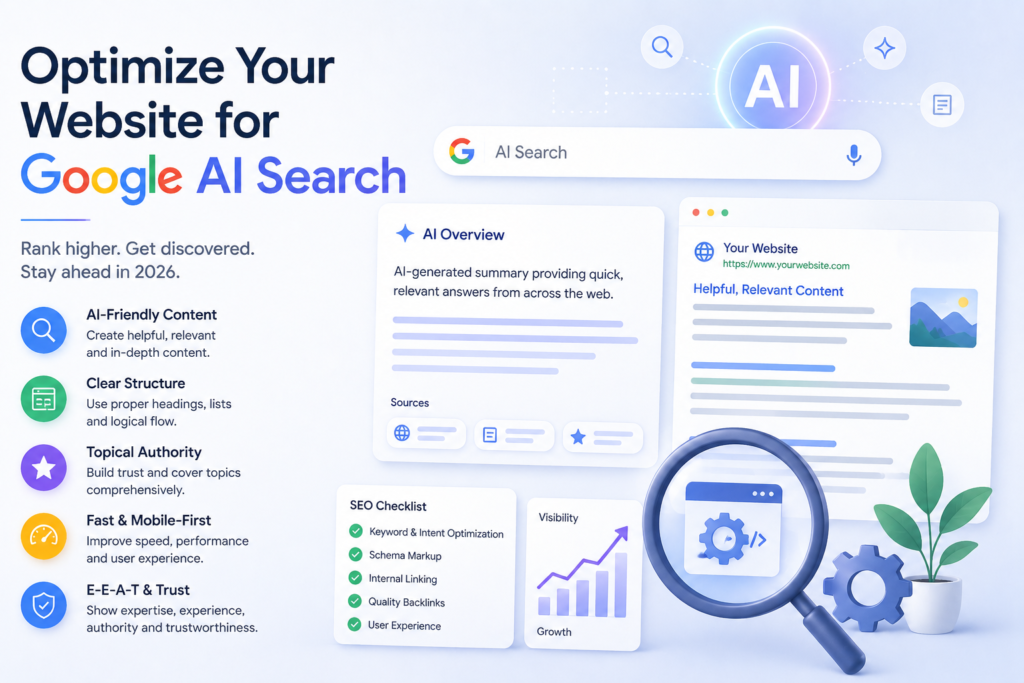
Google AI Search
There isn’t a magic “AI SEO” button.
Instead, focus on the fundamentals.
1. Create Original Content
Don’t simply rewrite the top-ranking articles.
Add:
- Experience
- Examples
- Data
- Expert opinions
- Case studies
- Original analysis
- Practical recommendations
Google’s guidance says unique viewpoints and first-hand experience can make content more valuable than simply repeating information already available online.
2. Answer Real Customer Questions
Build content around questions your customers actually ask.
For example:
Question:
How much does SEO cost in Delhi?
Better content:
Explain SEO pricing factors, different service models, what affects cost, what businesses should expect and how to evaluate an SEO provider.
This creates a much more useful resource than simply repeating the phrase “SEO company in Delhi” throughout the page.
3. Use Clear Content Structure
Make your pages easy to understand.
Use:
- One clear H1
- Descriptive H2 headings
- Short paragraphs
- Bullet points
- Tables where appropriate
- FAQs
- Examples
- Relevant images
- Strong internal links
Google says there is no ideal word count for AI Search. Write as much as the topic and audience actually require rather than targeting an arbitrary number.
4. Strengthen Your Business Trust Signals
For a digital marketing agency, your website should clearly communicate:
- Who you are
- What services you provide
- Where you operate
- Who your team is
- What experience you have
- What industries you serve
- Client testimonials
- Case studies
- Contact information
- Business credentials
Google’s people-first content guidance emphasizes demonstrating expertise and providing information that helps users trust the site and its authors.
AI Search + Local SEO: A Major Opportunity for Businesses
Local businesses should pay particular attention to AI Search.
Consider a query such as:
“What are the best digital marketing agencies in Delhi NCR for a small business?”
A business needs more than a page containing the words “digital marketing agency in Delhi.”
Its website should clearly communicate:
Business + Services + Location + Expertise + Trust
For example:
ResultWise Digital provides SEO, Google Ads, social media marketing, website development and lead generation services for businesses in Delhi NCR.
Then support those claims with dedicated service pages, useful articles, testimonials, contact information and relevant business information.
Google also recommends keeping Business Profile information up to date for relevant search experiences.
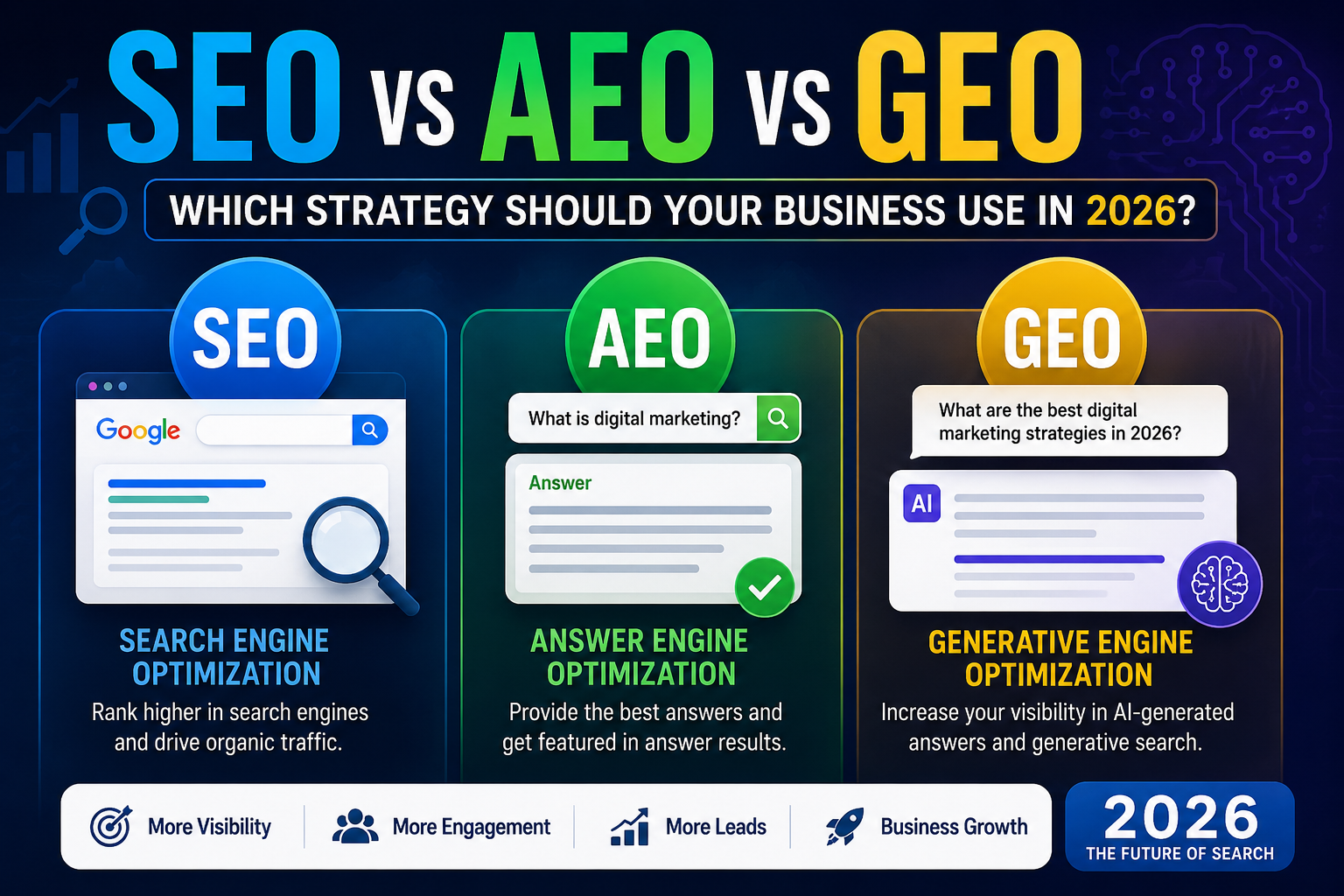
Is GEO or AEO Replacing SEO?
No.
You may have heard terms such as:
- GEO — Generative Engine Optimization
- AEO — Answer Engine Optimization
- AI SEO
- LLM Optimization
These describe strategies people use to think about visibility in AI-powered search environments.
But Google itself says the fundamentals of SEO remain relevant for generative AI search. It also cautions against focusing on so-called “AEO/GEO hacks” instead of effective SEO and valuable content.
So the better approach is:
SEO + Helpful Content + Technical SEO + Authority + User Experience + Business Trust
rather than trying to find a shortcut to manipulate AI results.
Does AI-Generated Content Rank on Google?
AI-generated content is not automatically excluded from Google Search.
The important question is whether the content provides value and complies with Google’s policies.
Google states that generative AI can be useful for research and content organization, but producing large amounts of pages without adding value can violate its spam policies, including policies concerning scaled content abuse.
For businesses, the safest approach is:
Use AI as a tool — not as a replacement for expertise.
For example:
AI can help you:
- Research topics
- Create outlines
- Find content gaps
- Organize ideas
- Improve readability
But your final content should include your own:
- Expertise
- Examples
- Experience
- Analysis
- Data
- Recommendations
- Brand perspective
The Future of SEO in 2026 and Beyond
SEO is not disappearing.
It is becoming broader.
The old model looked like:
The emerging model looks more like:
Question → AI/Search Discovery → Supporting Sources → Website Visit → Trust → Conversion
This means businesses should stop creating content exclusively for search engines.
Instead, create the best possible answer for the customer.
Google’s current guidance emphasizes that content created to genuinely help people remains the strongest foundation for visibility across both traditional Search and generative AI experiences.
10-Step Google AI Search SEO Strategy for 2026
Use this checklist when optimizing your website:
- Perform keyword and search-intent research.
- Create original, people-first content.
- Answer real customer questions.
- Build topical authority around your services.
- Strengthen internal linking.
- Improve technical SEO and crawlability.
- Optimize mobile experience and page speed.
- Use accurate structured data where appropriate.
- Build genuine authority and trust.
- Monitor Search Console, traffic and conversions.
And remember: Google does not guarantee that meeting every best practice will result in crawling, indexing or inclusion in AI features.
Conclusion
Google AI Search is changing SEO — but it is not killing SEO.
The biggest change is that search is becoming more conversational, contextual and exploratory.
Businesses that focus only on keywords and rankings may struggle to keep up.
Businesses that focus on helpful content, technical SEO, topical authority, trust, user experience and genuine expertise will be better positioned for the evolving search landscape.
In 2026, the question is no longer simply:
“How do I rank #1 on Google?”
The better question is:
“How can my website become the most useful and trustworthy source for the questions my customers are asking?”
That is the direction SEO is heading.
And businesses that start adapting now can build a stronger foundation for visibility, traffic and leads across both traditional Google Search and AI-powered search experiences.
About ResultWise Digital
ResultWise Digital is a digital marketing agency providing SEO, Google Ads, social media marketing, website development, content marketing and lead generation solutions for businesses.
If your business wants to improve its visibility in Google Search and prepare for the evolving AI-powered search landscape, a strong combination of SEO + high-quality content + technical optimization + conversion-focused website development can create a sustainable digital growth strategy.
Ready to improve your online visibility? Talk to ResultWise Digital today.